
Happy New Year! A Reflection on Christmas, Comedy, and Conflict
We have just experienced the time of year where we all strive to believe (or is it pretend?) that the "Holidays of Light" are about spiritual enlightenment. And they are, but let’s be honest: the reason every culture on earth has a light festival in December is because in the Northern Hemisphere, it is pitch black outside at 4:00 PM and we are all collectively losing our minds. We aren't lighting candles for tradition; we’re lighting them as a distress signal. We are frantically illuminating our homes to prove to our neighbors—and the ghosts of our past—that we are definitely, 100% fine.
And what about the Southern Hemisphere, you ask? Don’t they have endless hours of sunshine? Yes, it’s true, but that’s because the Northern Hemisphere has so dominated global culture that they have no other choice but to endure "White Christmas" imagery while standing in a heatwave. It’s less of a choice and more of a global mandate.
Is There Really Peace on Earth?
Henry Wadsworth Longfellow once wrote:
"And in despair I bowed my head; 'There is no peace on earth,' I said; 'For hate is strong, and mocks the song of peace on earth, good-will to men!'"
He wrote that during the Civil War, but you don't need a battlefield to feel the "mockery" of that song. You just need to check the news, read about the daily chaos, or—more relatable for most of us—after preparing with pure intent for an enjoyable holiday, try to navigate a dinner with relatives and friends who have conflicting opinions, values, and life experiences.
And that’s the easy part. How is it possible to happily navigate a season that is presented as one of hope and light when facing real-life challenges like intractable physical and mental illness, relationships that seem unable to be healed, or financial problems that make the materialistic demands of Christmas a burden rather than a joy? The world is at war, the news is a horror show, and even in our personal lives, "peace" feels like a marketing slogan for a candle we can’t afford.
Why We Need the Conflict
This is where comedy comes in. Comedy gives us a safe place to deal with the fact that the world is a mess. Think about your favorite holiday movies; they almost always center on conflict. If you look at the most beloved holiday films, they aren't about peace—they are about survival:
Home Alone: Child abandonment and home invasion.
Elf: Identity crisis and a cold, workaholic father.
Christmas Vacation: Mental breakdowns and kidnapping.
A Christmas Story: Bullying and intense parental pressure.
Die Hard: ...well, terrorists.
People don't love these movies because they are "peaceful." They love them because they show people surviving absolute chaos. Even before we watch them, we know—perhaps subconsciously—that things will work out. Because we know there is a happy ending, we are able to endure and even laugh at the conflict. This helps us, in a safe way, work through the feelings of our own personal struggles.
Older classics utilize this same formula:
How the Grinch Stole Christmas: Whether it’s the original cartoon or the Jim Carrey version, it relies on the Grinch’s sarcastic, "deadpan" humor. It’s funny because of the absurdity of a creature trying to "stop" a holiday with a dog dressed as a reindeer.
It's a Wonderful Life: While not a comedy per se, it is a drama with profound "comic relief." The humor (like the bumbling angel Clarence) makes the characters feel human and relatable so we don’t get overwhelmed by the darkness of the core story: debt, loss of dreams, and near-suicide.
Miracle on 34th Street: This is a lighthearted drama where the comedy comes from the absurdity of a courtroom trial trying to prove that a man is Santa Claus. It has a witty, sophisticated humor that keeps the mood hopeful despite the conflict of a sanity hearing.
A Masterclass in Dark Comedy
Then, there’s the granddaddy of holiday conflict: A Christmas Carol.
I recently went to Silver Dollar City in Branson and saw the play. While we think of A Christmas Carol as a morality tale, it is secretly a masterclass in dark comedy. Scrooge isn't just mean; he’s sarcastic. He’s a man in deep distress using cynicism as a shield against every good person, deed, and opportunity he is presented with. As a psychologist would say, “Mr. Scrooge has very little self-insight.”
At Silver Dollar City, the Ghost of Christmas Present was the highlight because she was relentlessly sarcastic with Scrooge. Every time they saw something genuinely good—Tiny Tim’s spirit or his nephew’s kindness—she threw Scrooge’s own hateful words back in his face with a wink. It was a "punch-up" from the universe. It also makes me wonder if the universe will punch me back someday for all my own hateful words and deeds. Comedy allows us an avenue for that kind of necessary self-reflection.
The Ghosts We Carry
Don’t we all face these conflicts?
The Ghost of Christmas Past represents "what could have been" in our own lives. It is hilarious but heartbreaking. We have all made decisions that, in hindsight, bring remorse or regret. The tragedy and cold reality is that we can’t recreate the past; we can only learn from it. Watching Scrooge’s mistakes gives us the one thing he lacked: the "safe distance" of a comedy to realize we might be acting like a jerk before the clock strikes midnight.
The Ghost of Christmas Present is the reality that there is no "peace on earth" globally or even in our personal lives. How do you feel peace in the present when you face serious challenges? Whether it’s navigating the clinical bureaucracy of a medical unit, sitting in the quiet tension of a family dinner where certain topics are landmines, or dealing with financial pressures, the present is often heavy.
It reminds me of the classic Dan Fogelberg song, "Same Old Lang Syne." Two old lovers meet in a grocery store, drink a six-pack in a car, and reminisce until they feel like younger versions of themselves. It feels like the "snow"—beautiful, light, and nostalgic. But the song doesn't end in a romantic embrace. It ends with him standing alone:
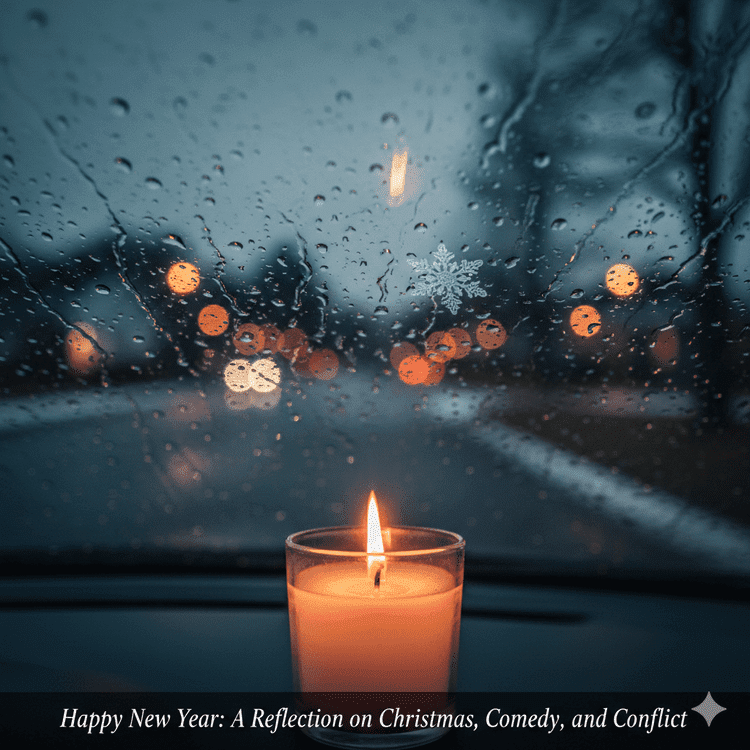
"And as I turned to make my way back home / The snow turned into rain."
That line is the ultimate New Year’s truth. The snow—the nostalgia and the "perfect" holiday we tried to manufacture—inevitably turns to rain. It becomes heavy, cold, and dreary. We realize that we are different people now, facing different battles, and we simply cannot go back to the way things were or the way we imagined them to be.
Moving Forward
This brings us to the Ghost of Christmas Yet to Come. In our lives, that isn't a scary, hooded figure; it is the New Year itself. It is the realization that while we cannot go back to the "snow," we can face the "rain" with our eyes wide open.
There is a melancholy in realizing the past is gone, but there is also a profound freedom. When we stop pretending that everything is "100% fine" and start dealing with the world as it actually is, we can progress and feel greater joy. We can use Comedy to keep our pressure valves from blowing, and we can use the Conflict to fuel our advocacy for the people we love.
So, Happy New Year, my friends. The snow has turned to rain and the candles are burning low. But the greatest gift is that the sun is going to stay up a little longer tomorrow, and the next day, until we find ourselves in the new life of spring and the warmth of summer.
Despite whatever individual hardships and challenges we face, it is time to shift out of park, put our lives in gear, and move into 2026 in the best way we can.
